
Early Intervention Program — COMING SOON! Comprehensive services for children from birth to age 3. Email infoei@ocservices.org for details.

thumb

What is Early Intervention

Early Intervention is a special program for babies and toddlers from birth to three years old who have delays in their development or who have been diagnosed with a condition that could affect their growth. It is a time when young brains are growing fastest, when small changes can make big differences, and when families learn they are not alone.

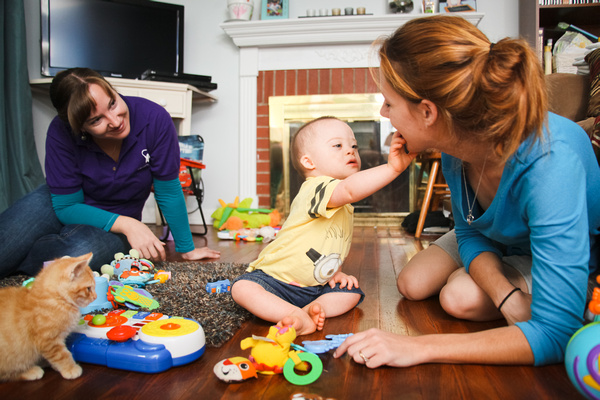
The program brings trained professionals into your home, community or childcare center. They coach you and your family to help your child in familiar, comfortable places. They coach through play, daily routines, and the loving interactions that happen naturally throughout the day. Most importantly, they teach you—the caregiver—how to support your child’s development in ways that fit your family and culture.

Early Intervention is not about fixing what is wrong. It is about building on what is right, celebrating each small victory, and giving every child the best possible start in life.

Early Intervention Services

Optimal Care Services provides a complete range of Early Intervention services to meet the unique needs of each child and family. Our team of caring professionals works together to support your child's growth and development:

Service Coordination:

A dedicated professional who helps you navigate the Early Intervention system, coordinates all services, and ensures your family gets the support you need.

Multidisciplinary Evaluations:

Comprehensive assessments by a team of specialists to determine if your child is eligible for Early Intervention services and to identify their unique strengths and needs.

Special Instruction (SI):

One-on-one teaching that helps your child reach developmental milestones in areas like communication, problem-solving, movement, and social skills.

Applied Behavior Analysis (ABA):

Evidence-based therapy that uses positive reinforcement to teach new skills and reduce challenging behaviors, especially helpful for children with autism.

Speech Therapy (ST):

Support for children who need help with talking, understanding language, using gestures, or communicating their needs and feelings.

Speech with Feeding Therapy (STF):

Specialized therapy for children who have trouble eating, drinking, chewing, or swallowing safely and comfortably.

Occupational Therapy (OT):

Help with daily activities like getting dressed, playing with toys, using eating utensils, and developing fine motor skills like grasping and reaching.

Physical Therapy (PT):

Support for movement and physical development, including sitting, crawling, walking, balance, and building strength and coordination.

Social Work:

Counseling and support for families, help finding community resources, and guidance through challenging situations or transitions.

Psychological Assessments:

Professional evaluations to understand your child's development, identify concerns, and guide treatment planning.

All services are provided in your home or childcare center, in the language your family speaks, and at no cost to you.

How It Works

Acquiring EI Services For Your Child

1. Submit a Referral

A parent, doctor, or concerned party will refer a child for a free evaluation — with parental consent.

2. Meet Your Service Coordinator

A Service Coordinator is assigned to guide your family through every step of the EI process.

3. Schedule Your Evaluation

A team of specialists conducts a full evaluation to determine if your child qualifies for EI services.

4. Build Your IFSP

If your child qualifies, a personalized plan — called an IFSP — is created around your family's unique needs.

5. Services Begin

Qualified specialists are assigned to coach parents and caregivers in supporting their child's growth and development.

Who Can Benefit?

Early Intervention can help children who are experiencing delays or challenges in any area of development. You might notice that your child:

  • Is not reaching developmental milestones like rolling over, sitting up, crawling, or walking
  • Has trouble communicating or does not babble, gesture, or use words
  • Struggles with eating, drinking, or self-feeding
  • Does not make eye contact or respond to their name
  • Has difficulty playing with toys or interacting with others
  • Shows unusual reactions to sounds, touch, or movement
  • Has been diagnosed with a condition like Down syndrome, autism, cerebral palsy, or hearing loss

Hope for the Journey Ahead

We have seen babies who could not lift their heads learn to crawl and then run. We have heard first words from children who were silent for years. We have watched toddlers who avoided touch learn to give the warmest hugs. These moments are not just victories—they are miracles born from love, patience, and the right support at the right time.

Your child has unlimited potential. We are honored to help you unlock it.

Every child deserves the chance to shine. Let us help yours reach for the stars.
Early Intervention Services
FAQs

Frequently Asked Questions

Every child deserves a bright beginning. If you have ever wondered whether your little one might need some extra support, you are not alone. Many families have questions about Early Intervention — what it is, how it works, and how to get started. The answers below are written in plain, simple language so that every family can feel informed, empowered, and hopeful.

Early Intervention (EI) is a special program for babies and toddlers — children from birth up to age 3 — who may be growing or learning a little differently than other kids their age. It gives these children extra help and support so they can grow strong and learn new skills. Think of it as a team of caring therapists who come to you, right in your home or wherever your child spends time.

EI is for children from birth to their third birthday who have a delay in one or more areas of growing, such as talking, walking, thinking, or playing. It is also for children who have a medical condition that may cause a delay later. Any child — no matter where they live, how much money their family has, or what language they speak — may be able to get help.

You may want to ask about EI if your child is not reaching the steps other kids their age is reaching. Some signs to watch for: not smiling by 3 months, not babbling by 12 months, not walking by 18 months, not saying two words together by 24 months, or losing skills they once had. Trust your heart — you know your child best. If something feels different, it is always okay to ask.

The first step is a referral. Anyone can make a referral — a parent, a doctor, a teacher, a neighbor, or even you yourself. After the referral, a team of trained therapists will meet with your child and your family. They will watch your child play, ask you questions, and do some friendly checks to see how your child is growing. This is called an evaluation. It is free, and it does not hurt.

The evaluation — the check to see if your child qualifies — is always free. Services are also free regardless of social or economic status. Some services may be billed to your health insurance without impacting your premiums. Your service coordinator will walk you through all this step by step.

EI can offer many kinds of help based on what your child needs. Some examples are speech therapy to help your child learn to talk or understand words; physical therapy to help with moving, crawling, or walking; occupational therapy to help with playing, feeding, and using their hands; special instruction to help with learning and thinking, and service coordination to help your family navigate the whole process.

EI services happen in your child's natural environment — the places where they live, play, and learn every day. This usually means your home, a grandparent's home, a childcare center, or a park. The goal is to help your child grow in real life, not just in a clinic. Expert therapists come to you—whether in-person or via telehealth (live video and audio), which makes it easier for your whole family to be part of the learning.

Yes — and your voice is the most important one in the room! EI is built around the whole family. You will work closely with the team to create a plan called an Individualized Family Service Plan, or IFSP. This plan is about your child's goals and your family's needs. You decide what matters most. Our expert therapists are there to support you, not to replace you. You are your child's greatest teacher.

When your child gets close to their third birthday, your service coordinator will start talking with you about what comes next. This is called transition planning. If your child still needs support, they may move into a preschool program through your local school system, such as special education services. Your service coordinator will help make sure the change feels smooth and safe.

Yes — research shows that the earlier a child gets help, the bigger the difference it can make. The young brain grows fastest in the first three years of life. When children get the right kind of support during this special time, many of them catch up to their peers, build stronger skills, and go on to do wonderful things. Early Intervention is not about fixing a child — it is about giving every child the best possible start for a glowing future.

The Early Intervention Program (EIP) is a public program funded by New York State, Nassau, and Suffolk counties, and the NYC Department of Mental Health, and is for children less than three years of age, who have or are suspected of having a developmental delay and/or disability. Eligibility for EIP can be determined only by State aproved evaluators under contract with the municipality. If a child is found eligible for the EIP, all services are identified in collaboration with the family and must be authorized by the municipality.The municipality will arrange for service providers to deliver services authorized by the municipality. All services under the EIP are approved at no out-of-pocket costs for families, but health insurance may be accessed, without affecting your family's benefits. For services provided in community settings that require a fee, the parent is responsible for paying those costs. To access EI services, contact the Nassau County Department of Health at 516-853-3100. To access EI services within New York City, contact the NYC Help Line at 311. Optimal Care Services is an approved provider of Early Intervention services under contract with New York State Department of Health; a New York State Education Department-approved Special Education Itinerant teacher (SEIT) service provider, including bilingual SEIT, Special Education Teacher Support and Services (SETSS); Pendency; and a Continuing Teacher and Leader Education (CTLE) sponsor. The committee on Preschool Special Education (CPSE) program is funded and regulated by the NYS Education Department, county, and your local school district for children 3-5. Services are provided at no direct cost to families for children who meet eligibility guidelines.